
 Serhii Rudiuk
Political Expert

The issue of war crimes and the responsibility of states for them is important in international relations. This is evidenced, in particular, by such current international legal acts as the UN General Assembly Convention on the Prevention and Punishment of the Crime of Genocide of December 9, 1948, as well as the 1950 European Convention for the Protection of Human Rights and Fundamental Freedoms, the 1966 International Covenant on Civil and Political Rights, the 1968 UN Convention on the Non-Applicability of Statutory Limitations to War Crimes and Crimes Against Humanity. For example, France legally recognizes the genocide of Jews and Roma during the Second World War, the genocide of the Tutsi people in Rwanda in 1994, and the genocide of Armenians at the end of the First World War in Turkey. The Armenian genocide was also recognized in Germany, Italy, and the Netherlands…
According to the information of the National Holodomor Genocide Museum, as of August 3, 2023, the Holodomor of 1933 in Ukraine was recognized as an act of genocide against Ukrainians by 28 countries of the world. However, the efforts of some states to baselessly accuse the Ukrainian people of committing crimes against other peoples by Ukrainians, or by their individual representatives, are known. Thus, in the document “Information on the Results of the Official Visit by the Ukrainian Government Delegation Led by the Minister of Foreign Affairs of Ukraine to the State of Israel” (July 10–12, 1995) prepared for the state leadership of Ukraine, we read about Israel’s “pushing” the Ukrainian delegation to recognize “Ukrainians’ crimes against Jews”. To which the Ukrainian delegation “clearly and firmly proved the official position regarding the fact that our state has nothing to justify for someone else’s crimes against Jews. Both nations have borne the brunt of the tragedy of violence. And therefore, Ukraine’s position in relations with Israel should be more demanding and devoid of any historically conditioned reservations”.
The same should be Ukraine’s position regarding Poland, whose Sejm adopted a resolution on establishing July 11 as a national day of remembrance “for the victims of the genocide committed by Ukrainian nationalists against the citizens of the Second Polish Republic”. In an interview with the Polish newspaper Gazeta Wyborcza, Hero of Ukraine, MP Yurii Shukhevych characterized it as follows: “A hypocritical, provocative and chauvinistic text from the first to the last sentence”.
Indeed, the efforts of the political elites of individual states to shift their guilt before the Ukrainian people onto the Ukrainians themselves are more like slander. Historical facts confirm this thesis. For example, about Ukrainian-Polish relations in the period from the second half of the 19th to the beginning of the 21st century.
Halychyna As Part of the Austrian Empire
…In 1772, the Austrian Habsburgs included Halychyna (Galicia) in their empire. And in 1861, the region received autonomy from official Vienna with its own Parliament (Diet, Sejm). However, at the request of Poland, out of 150 places of Ambassadors (MPs), only 49 were allocated by the Austrian authorities to Ukrainians. Subsequently, the Sejm of Galicia itself introduced the so-called curial electoral system, which reduced the number of Ukrainian deputies to 14, and later even to 11. The absolute majority of the Poles in the Sejm gave them the right to legislate and govern the region, and they were quick to take advantage of it. In particular, in 1867, Polish was declared the official language of Halychyna instead of German. This made it possible to polonize Lviv University, vocational, secondary, and, to a large extent, primary education. In this way, the Poles tried to slow down the growth of the Ukrainian intelligentsia. In 1897, out of 14,000 secondary school students in the province, 80 % were Poles, while Ukrainians accounted for only 16 %. Poles had 30 gymnasiums to study at, while Ukrainians had only two. At Lviv University, Ukrainians made only 30 % of students. In 1911, out of almost 80 university professors, only 8 were Ukrainians.
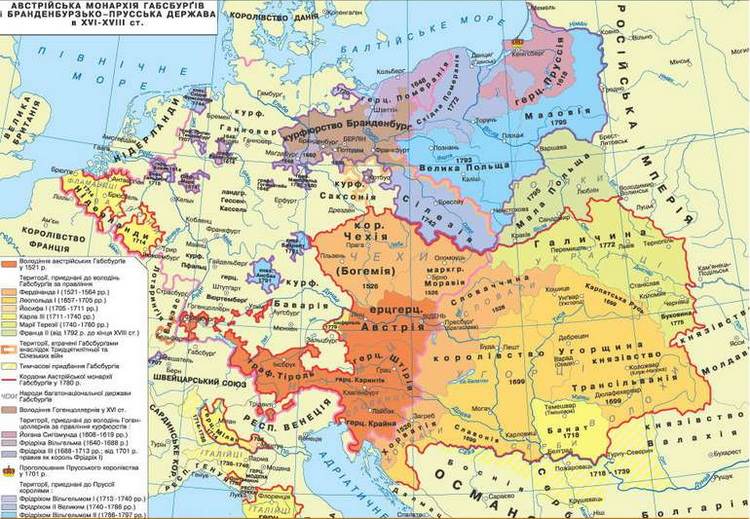 Halychyna as part of the Habsburg Empire.
https://umity.in.ua/concept/?id=826
As a result, the number of Ukrainian intellectuals in Halychyna was about 5,000, clergymen included, while the number of Polish intellectuals was 38,000, clergymen included. In 1914, 300 high ranking government officials in the province were Poles, and only 25 — Ukrainians. Subsequently, the Polish representative at the Paris Peace Conference took advantage of this artificially created situation, which was offensive to Ukrainians, stating: “Ukrainians are a nation of peasants and clergymen. That is why they are not allowed to have their own state. Because they do not have an elite capable of governing it!”
Land relations were also unfair to Ukrainians. In 1900, 95 % of Ukrainians in Halychyna lived from agriculture. Of those, 80 % were land-poor, as 45 % of the arable land belonged to about 2,400 Polish landowners, and the remaining 55 % of the farmland was distributed among thousands of tiny peasant farms. Landlessness caused massive emigration of Ukrainians from Halychyna to America and Canada.
Taking advantage of their privileged political position, the Polish colonial elite resorted to a policy of economic and national oppression of the indigenous Ukrainian population of Halychyna, similar to the policy of the Russian government in Dnipro Ukraine (Naddnipryanshchyna). Any attempts by Ukrainians to achieve at least equal rights with the Poles were ruthlessly suppressed by armed force. Thus, during the elections to the Sejm of Halychyna in 1895 and, especially, in 1897, gendarmes with weapons dispersed pre-election meetings of Ukrainian peasants. In the process, 29 people were injured, 9 men were killed, and more than 800 were arrested and imprisoned. Even socialist Poles reacted to this: they sent donations to help the families of the victims. They declared that “the Polish minority’s domination over the Ukrainian majority is immoral” and that in the future it “cannot be saved without the army and gendarmerie”…
During the 1907 parliamentary elections, the terror of the Polish administration continued: 20 Ukrainian peasants were wounded, 4 were killed. During the 1908 Sejm elections, the Polish terror intensified even more. At a pre-election meeting in the village of Koropets gendarmes stabbed with bayonets peasant leader Marko Kahanets, and famous Polish writer Henryk Sienkiewicz publicly insulted Ukrainian student prisoners — participants in a political hunger strike, for which even an Austrian court found him guilty.
However, the Polish chauvinists of that time did not relent and did not agree to any concessions to the Ukrainians…
But soon the First World War began. While the Ukrainian Sich riflemen were fighting the Russian army, the Polish governor of Halychyna, Korytowski, set out to destroy nationally conscious Ukrainians: the headquarters of each Austrian army received thirty Polish agents, who represented such Ukrainians to the Austrian military as Muscophiles and, thus, made them doomed to destruction, because the army, especially the Hungarian one, knew nothing about Ukrainian affairs and executed everyone who called himself “Rusyn”. Thus, thousands of innocent Ukrainians ended up in Austrian concentration camps, where many of them died from the inhuman conditions of detention.
Returning to Halychyna, the Austrian army organized roundups and mass executions of Ukrainians, accusing them of sympathizing with Russia. Judge Zagurski, a Pole by nationality, who sentenced more than a hundred Ukrainians to death… On September 15, 1914, the Hungarian Honvéd (army), based on Polish slander, beheaded more than forty Ukrainians with sabers on the streets of Przemyśl. General statistics indicated that 36,000 Ukrainian civilians, including the elderly, including women, were shot or hanged, and the same number died in concentration camps. At the same time, not a single Polish Muscophile from the “Greater Poland” party was arrested, even though its members did not hide their hostile attitude to Austria. During the Russian occupation of Halychyna in 1914, the same Muscophiles-Poles helped the Russians destroy Ukrainian educational and cultural institutions, arrest prominent Ukrainian political, church and cultural figures.
The extermination of Ukrainians continued throughout the Polish-Ukrainian war of 1918–1919. It was started by the Polish underground organizations of Lviv on November 1, 1918, by shooting at Ukrainian military patrols… It is believed that the combat losses of the Ukrainian Halychyna Army in the Polish-Ukrainian war of 1918–1919 reached more than 15 thousand people.
The Polish fighters massively involved teenagers in the hostilities against the Ukrainians in Lviv, which is prohibited by the international law on war. Therefore, the so-called Lviv Eaglets (Orlęta lwowskie) are actually not heroes, as they are represented in Poland today, but juvenile war criminals.
In that war, the Polish government did not comply with the agreement between the Ukrainian and Polish parties of February 1, 1919, regarding the treatment of prisoners of war and internees, as well as the additional agreement of March 11, 1919, concluded in the presence of a representative of the Swiss Red Cross….
In Halychyna, the Poles not only fought with the Ukrainians for power, but also systematically and en masse exterminated them. This is evidenced by numerous facts of Polish violence against the peaceful Ukrainian population, given with a list of places, names and dates in the “Bloody Book”, published by the government of the West Ukrainian People’s Republic in Vienna in 1919. It states that no less than 250,000 peaceful Ukrainian citizens of various ages and genders ended up in prisons and internment camps. Prominent Ukrainian public figures were behind bars — members of parliament, university and high school professors, as well as teachers, lawyers, notaries, doctors, engineers, priests, monks, and various government officials…
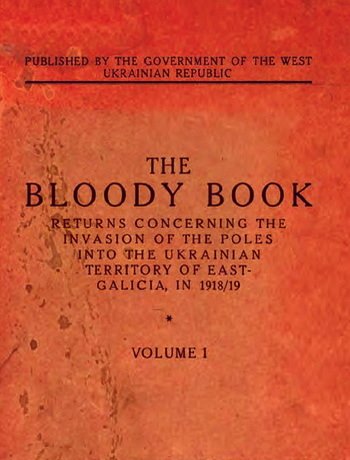 |
| “The Bloody Book”, published by the government of the Western Ukrainian People’s Republic in Vienna in 1919. https://diasporiana.org.ua/wp-content/uploads/books/22815/file.pdf |
For example, in Solotvyn, in the forest, near the village of Pryslop, on June 10, 1919, Polish commander Podwysocki shot dead a 66-year-old member of the Ukrainian government, state secretary (minister) of land affairs and former Austrian advisor to the court, engineer Mykhailo Martynets, on his way to interrogation. The criminal bragged after he had shot the “Haidamak minister” with his own hand…
Polish military authorities organized the entire civilian Polish population of the cities and villages of Halychyna, regardless of age and gender, into combat organizations and armed them. Their task was to terrorize the Ukrainian civilian population. The main features of such organizations were chauvinism and the desire to annoy Ukrainians.
Not only Polish soldiers and civilians, but also the clergy joined in the abuse of Ukrainians. Thus, in Kolomyia, the Polish clergyman (catechist) Klus shot Ukrainians and encouraged Polish teenagers to do the same. According to the “Bloody Book”, during the years 1918–1919, the servicemen of the Polish Army without investigation and trial executed in the most brutal way two voivods, seven clergymen, 11 civilian intellectuals, 117 prisoners in 38 cities, 154 peasants in 45 villages, 31 women, 21 children. A total of 355 civilians. These are only those that were recorded, but how many of were killed exactly?
In the camps, Ukrainian prisoners and internees were exterminated by hunger, cold, unspeakably difficult hygienic conditions and diseases. Those were real death camps. According to sources, 30–40 prisoners of war died every day in the Dombie camp in 1919, 50 each in Brest and Pykulychi, and 50 to 100 in Strzałkowo.
The Warsaw “Robotnik”, the newspaper of the Polish Socialist Party (Issue 339 of October 16, 1919) published the article “Prisoners’ Camps”, which reported: “The camp for prisoners in Brest Litowski is an abomination, it is a shame for the Polish state… Two months ago, 50–100 corpses daily were taken away from the camp, which had about 6,000 prisoners… The conditions of Ukrainians’ stay can lead to despair… These conditions, combined with starvation and rampant diseases, turned the camp into a camp of corpses…”
There are reasons to claim that the Polish side used bacteriological weapons against the Ukrainian Halychyna Army (UHA). It is known from the UHA diary that a typhus epidemic among personnel began in the fall of 1919 in the area of the front, where the II UHA Corps and the Sich Riflemen Group, advancing on Korosten, captured by the Russians, had on their left side “friendly” Polish divisions of General Józef Haller. In the second half of November, the II UHA Corps already had 110 sick officers and 3,900 typhus-infected rank and file riflemen. Since the French government, sympathizing with the Russian chauvinist Denikin, blocked the supply of medicines to the Ukrainian People’s Republic, which was at war with the Russian Bolsheviks, the epidemic could not be stopped. Dr. Burachynskyi, the Chief Doctor of the UHA, pointed out in his report: “Our army no longer looks like an army, it is no longer even a hospital, but a traveling corps of corpses”.
Research in the archives of the Pasteur Bacteriological Institute in Paris in the 1940s, found out forensic documents, from which it appears that in the spring of 1919 someone stole bottles of typhoid serum from there. Woskresiński, a Pole, went through the investigation as a suspect.
In turn, the behavior of the Polish “partners” during the famous Polish-Ukrainian campaign of 1920 in Kyiv was described by Symon Petliura’s adjutant Osavul Oleksandr Dotsenko in the “Chronicles of the Ukrainian Revolution”: “Rivne, where the Ukrainian High Command, the Group Headquarters, the Ukrainian government were located, is now unrecognizable; full of Polish military, gendarmes, police; the signs are repainted in Polish, the Polish language can be heard everywhere. The Poles did it this way, because they believed that where they were, everything was theirs… Unheard things were being told about the Poles’ oppression of Ukrainians — civilians and servicemen; about shootings and hangings in Shepetivka area by counter-intelligence of the 13th Polish Division, which included many former Russian officers”.
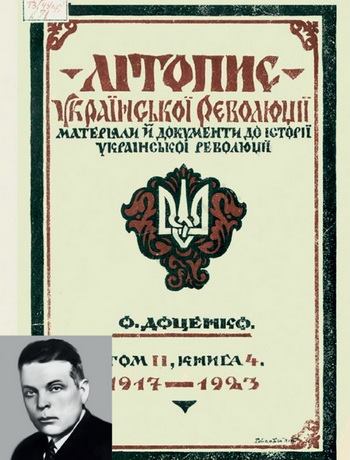 |
| The book “Chronicle of the Ukrainian Revolution” by O. Dotsenko. https://prysiaga1919.org.ua/?p=109 |
And at the end of November 1919, head of the Polish state, the socialist Józef Piłsudski, through the mediation of his old acquaintance, also a socialist, Julian Marchlewski, concluded a secret agreement with the Lenin government on a cease-fire. This enabled the Bolsheviks to direct all their forces against the Ukrainians.
Thus, with the joint efforts of Poland and Russia, with the political and military support of the “liberal” West, the West Ukrainian People’s Republic and the Ukrainian People’s Republic were destroyed, and the ethnic territory of the Ukrainian people was divided between their neighbors. Ukrainians, deprived of the protection of their own state, experienced new waves of terror from foreign occupiers.
Pacification and Its Consequences
In the second half of the summer and autumn of 1930, Polish authorities conducted an armed operation in Halychyna — a so-called pacification. These were searches, closures and destruction of Ukrainian cultural and educational and economic institutions, Prosvita’s reading rooms, cooperative shops, looting and destruction of cooperative goods, desecration of graves of Ukrainian warriors, monuments to Taras Shevchenko. Polish military and police officers detained village activists, including: a teacher, a clergyman, the head of a cooperative, the head of a reading room, and others based on pre-compiled lists. Such people were driven into a barn and beaten to unconsciousness with thick sticks from flails. Often the victims received 200 and 300 blows. Those beaten and unconscious from that were locked up in the pit, where they were without water and care for their wounds — they were denied medical assistance.
In the memorandum of the Ukrainian People’s Council to the League of Nations (predecessor of the UN) dated January 10, 1931, more than 350 villages through which the punitive expedition passed are listed by name; points to 212 looted, vandalized and destroyed cooperative shops that were smashed by bombs, axes, etc.; recorded 69 ruined and destroyed cultural and educational institutions, 12 damaged schools, more than 40 rural communities where the property of villagers was illegally requisitioned; and also mentions 1,357 adult men, women, the most nationally conscious, public workers, members of cooperative societies, Prosvita’s reading rooms, including teachers, who were beaten in one way or another with whips, butts, sabers, sticks (up to 500 blows), about 93 children from 6 to 16 years of age (among them many students of Ukrainian schools, who were also beaten with sticks, whips and carabine butts).
According to statistics compiled on the basis of the above-mentioned memorandum and other sources, the approximate number of victims of violence of the “Polish civilization” is given: 441 “pacified” villages, 427 destroyed Ukrainian cooperatives, libraries, schools and other institutions, more than a thousand looted peasant farms, 2,340 brutally beaten peasants, 27 persons were killed or died of wounds. Descriptions of “pacification” were published in Ukrainian, French and English. The most detailed are “To the Eternal Shame of Poland” and “Polish Atrocities in Ukraine” (1931).
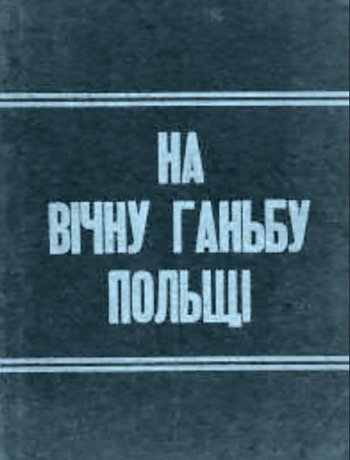 |
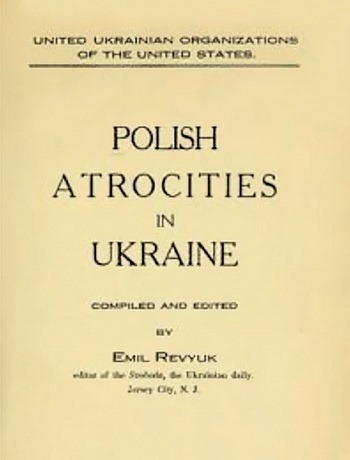 |
|
The book “To the eternal shame of Poland, the stronghold of barbarism in Europe”. https://diasporiana.org.ua/istoriya/1086-na-vichnu-ganbu-polshhi-tverdini-varvarstva-v-evropi/ |
Revyuk E. Polish Atrocities in Ukraine. https://diasporiana.org.ua/ukrainica/6752-revyuk-e-polish-atrocities-in-ukraine/ |
In Dnipro Ukraine, many Poles held high positions in the so-called bodies of the Soviet government, in the Red Army and the Cheka (Soviet secret police) and participated in the liquidation of Ukraine’s independence. Thus, in 1920, Moscow dispatched head of the Cheka, a Pole, Feliks Dzierżyński, to Ukraine (to the “independent” Ukrainian SSR). He, actually, carried out a bloody purge and “pacification” among the local national-independence movement. In particular, Poles, as the “first nation of Ukraine”, headed many regional and central bodies of the Communist Party in Ukraine during the Soviet era. In those most tragic years, the Pole Stanisław Kosior (from Mazowia) was sent from Moscow as the governor of Ukraine, First Secretary of the Communist Party of Ukraine. He and his fellow Russian party member Pavel Postyshev arranged the Holodomor and executions of the Ukrainian intelligentsia in 1928–1933. Of course, the Polish people cannot be blamed for this, but such facts, which speak for themselves, should not be silenced either.
We are glad that the Poles, not without the help of the Ukrainian army, managed to avoid the “happy life” that Dzierżyńskis and Kosiors prepared for them in 1920, but we cannot forget the crimes they committed against our people.
The Polish Underground and Its Allies
Poland continued its persecution of Ukrainians in the spring of 1939 in Carpathian Ukraine. And it did it together with Hungary. After all, both states viewed Ukrainians’ desire for freedom and independence as hostile. On March 18, 1939, the Polish consul in Bratislava, Mieczysław Chałupczyński, reported to Warsaw: “…Having studied the situation, I consider it necessary to recommend that Hungary carry out a rapid de-Ukrainization of Subcarpathian Rus without publicizing this action. The “cleansing” should be carried out under the guise of liberating the region from the communist element. The term “Ukrainian” should be banned by a secret circular in order to prevent the publicity of this case”.
The Polish side did not limit itself to recommendations to its Hungarian partner. Thus, the inspector of the Polish Army, General Kazimierz Fabrycy, wrote the following in a report to the General Staff of the Polish Army dated March 17, 1939: “During the destruction of active Ukrainian elements by the Hungarians, the escape of the former across the border is expected. The main task will be their liquidation”.
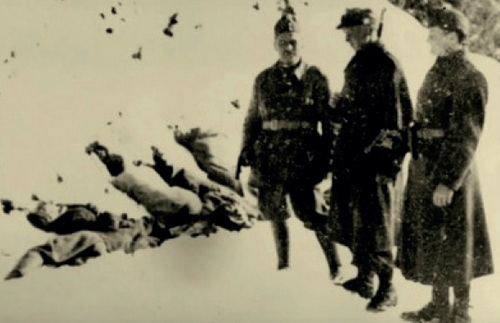
And those were not just words. According to oral testimonies collected by Ukrainian historians and researchers of local history during the years of Independence, on March 17, 1939, captured Carpathian Sich Riflemen from Halychyna were sent under a Hungarian military convoy in 7–8 columns of 70–80 people from the camp in Kryva and the prison in Tiachiv to the Veretskyi Pass. First, they were placed in barracks, but the next day they were handed over to Polish border guards. Polish border guards shot about 500–600 Sich riflemen from Halycnyna in two places 1.5–2 km from the border line above the villages of Verbiazh and Nova Rostoka and between Petrosovtsia, Župany and Lazy.
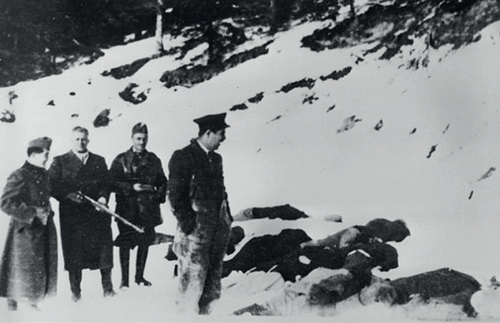
Another group of Sich riflemen was shot to the right of the pass from the side of Glukhivskyi Verkh and near Hlyboka Dolyna. On April 21, 1939, at the Uzhotskyi Pass, the Polish military, according to Ukrainian memoir sources, shot about 60 captured Sich riflemen, handed over to them by Hungarians. It is also known from memoir sources that another group of Halychians (30–43 people) were shot by Polish border guards and Hungarian soldiers, gendarmes and terrorists at the Tatar (Yablunetskyi) Pass near Yasinia on March 23, 1939.
 |
 |
|
Hungarian soldiers together with Polish soldiers in KOP uniforms over the mutilated bodies of the shot Sich members. https://www.istpravda.com.ua/articles/2017/10/19/151175/ |
Hungarian soldiers with a Polish border officer (in front) after the shooting of the Sich riflemen on the Tatar Pass near Yasinia. https://www.istpravda.com.ua/articles/2017/10/19/151175/ |
The executions on three Carpathian passes (Veretskyi, Tatarskyi, and Uzhotskyi) of Ukrainian prisoners of war, handed over by the Hungarians to the Polish military, were war crimes and were carried out in disregard of the requirements of the Hague Convention (IV) respecting the Laws and Customs of War on Land and its annex, namely Regulations concerning the Laws and Customs of War on Land, and the 1929 Geneva Convention on Prisoners of War.
When the German-Polish war broke out on September 1, 1939, the Polish government, once again disregarding international law, which prohibits the forcible mobilization of residents of the occupied territories into the army of the occupying power, drove thousands of Ukrainians to the front. According to some estimates, there were at least 150,000 of them in the Polish Army during the war. Among the dead Polish soldiers in 1939, Ukrainians made up 22 %, although the Ukrainian population made up only 14 % of Rzeczpospolita. There were 6,000 Ukrainians in the Polish Army of General Anders who fought against the Germans on the Western Front, in particular, they took part in the famous battle with the Germans near Monte Cassino in Italy.
In the autumn of 1939, about 60,000 Ukrainian soldiers of the Polish Army were captured by Germans, and 20,000 by Russians…
In the German-Polish war of 1939, the Poles were defeated. The Polish government emigrated. According to its decree of November 8, 1939, the underground Polish Home Army (Armia Krajowa) was created on the territory occupied by the Germans and Russians. However, that army and other Polish military organizations and groups, instead of fighting only with Germans, began to exterminate the unarmed Ukrainian population both with their own hands and with the help of German punishers who were provoked to repress Ukrainians.
Thus, in 1942, at the request of Moscow and by order from London, Armia Krajowa carried out a sabotage and diversion action under the code name “Wachlarz” on Ukrainian lands (Volyn, Kyiv region/Darnytsia, near Odesa). For each successful sabotage, the Germans took revenge on the peaceful Ukrainian population and political prisoners, in particular, members of the OUN. In 1942, in Rivne alone, the Germans shot about 70,000 people, including all Ukrainian political prisoners. Foreseeing the consequences of sabotage actions, the “Wachlarz” instructions forbade them to be carried out in areas populated by Poles.
The Ukrainian population was exterminated by German hands to please Moscow. From the very beginning of its existence in Ukrainian lands, the Polish armed underground cooperated with Red Partisans and created joint bases in the Polish colonies in Volyn. Pro-Russian partisan units of the Armia Krajowa in Volyn, such as Sobiesiak’s, Satanowski’s, and others, targeted the Ukrainian population, attacked Ukrainian villages, and provoked the Germans to repress local residents. Not all Poles were guilty of this, but the facts remain the facts: it was about the “liberation of the Eastern Borderlands (Kresy Wschodnie) from the Ukrainian presence”. And it was done in different ways. For example, in 1941, the commander of the Lviv district of the Polish underground military organization “Union of Armed Struggle” (Związek Walki Zbrojnej), Colonel Włodzimierz Młotkowski (“Młot”), arrested in 1941, agreed to cooperate with the NKVD in defeating, among other things, the Ukrainian national liberation movement, and received his freedom for this. After all, this is not the only case of a Polish-Russian or Polish-German “alliance” in the fight against Ukrainians.
The Poles had opportunities for this, because in the German occupation administration in Ukraine, and in Volyn in particular, as a result of political circumstances, there were many employees of Polish nationality: agronomists, pharmacists, foresters, translators, railway workers, doctors, in the paramilitary and construction departments, etc. As a result of such behind-the-scenes Polish-German-Moscow cooperation, Ukrainian villages and towns burned already in 1941 and 1942, and in 1943 Polish units burned down hundreds of villages in Volyn, and even where there was no UPA at all (that is, where they could do it and get away with it), such as in Senkevychivka or Ostrozhets districts. The extermination of Ukrainians by the Poles on the lands bordering the ethnic Polish territory (west of the Buh and Sian rivers) began in 1942. From 1942 to 1943, more than 2,000 Ukrainians, mostly intelligentsia, were killed there.
From May 1943 to May 1944, Polish underground formations in Kholmshchyna alone destroyed 52 Ukrainian villages. The extent of the genocide is evidenced by the fate of Sahryn village in Zabuzhzhia, where 260 households were burned and about 700 children, women and elderly people were killed. From August-September 1943, the Polish terror spread further east, to Halychyna and Volyn. As long as there was a Ukrainian militia there, organized without the permission of the Germans, there was no armed conflict with the Poles in Volyn. But when, as a result of German arrests and executions, Ukrainians from the local self-government and the Ukrainian militia went to the forests with weapons in early 1943, the Poles quickly took advantage of this “vacuum” and overran the local authorities, the Reich Commissariat, the police and the gendarmerie. The first action they did was direct the German repressive apparatus against Ukrainian patriotic villages of Volyn.
For example, according to the documents of the Rivne State Archive, Poles made up the absolute majority in the occupation institutions around Rivne. The German auxiliary police had the majority of them (11,000 people), Schutzmannschaft battalions — 1,500 people. And let’s not forget about the 7,000 Poles in the special units of the NKVD, who were called “red partisans” (there were 15 such Polish units in Volyn). Up to 30,000 Poles were part of the “extermination battalions” of the NKVD. And all these Polish units attacked Ukrainian villages, starting from March 17, 1943, to apply the principle of collective responsibility to the peaceful Ukrainian population (the village of Remel — 615 victims).
Not only Ukrainians suffered. In Volyn, apart from Polish colonies, there were Czech settlements. The Czechs supported the Ukrainian national liberation movement. There was even an initiative from the Czechs from the village Malyn (in the current Dubno district of Rivne region) to create a Czech branch of the OUN. Poles did not like the Czechs’ favorable attitude to the Ukrainians. They threatened them with revenge for this. And when the opportunity arose, they did take revenge. In July 1943, at night, Medvedev’s partisans robbed a mill in the village of Malyn, having taken flour from there, which the Germans also claimed. And this became the reason for a retaliatory action by the Germans, but not against the red partisans, but against the villagers. On July 13, 1943, a punitive German unit from Lutsk, reinforced by a Polish paramilitary battalion, surrounded the village, drove people to a wooden church and a barn, and burned them alive, preventing anyone from escaping. In this hell, about 800 people died — men, women, children, among them a Jewish doctor with a Polish wife and two small sons. Members of the local OUN unit led by the district OUN leader “Lysyi” came to the defense of the village — and all died in an unequal battle.
Within four months after the events mentioned above, Ukrainians were faced with a choice: to undergo complete physical destruction or to resort to an armed uprising. After fruitless negotiations with the Poles, on July 11 they raised an anti-Polish uprising. Because, as it became known from the documents intercepted by the UPA, the Polish underground scheduled a mass extermination of Ukrainians for July 15, 1943. The Poles did not have time to implement their plan. They themselves had to escape by fleeing to Poland. However, not everyone did so, as the Polish government-in-exile in London ordered the local Poles not to leave Volyn at the request of the UPA, because “…without the Polish population, Volyn will be lost for Poland forever”. That is, politicians in their actions were not guided by concern for people, but only by their own ambitions…
Mutual Exchange of the Population
The Polish government-in-exile constantly irritated Moscow with diplomatic demarches, demanding the establishment of the eastern borders of 1939 for the future restored Rzeczpospolita. Therefore, the Kremlin created its own puppet government of Poland. On September 9, 1944, the government of the Ukrainian SSR and the Polish Committee of National Liberation signed an agreement on the “mutual exchange” of the population. That is, Ukrainians were to be deported from the extreme western ethnic Ukrainian lands to the Ukrainian SSR, while Polish colonists were to return from Ukraine to ethnic Polish lands.
Ukrainians did not want to leave their native land. Then the “partners” used force against them. In April 1945, a wave of arrests of intelligentsia, clergymen and conscious peasants swept through Lemkivshchyna (Lemko region). The aim of the action was to demoralize the peasant masses, to deprive them of the leading stratum. The controlled terror of local Poles against residents of Ukrainian villages also intensified. Terror was supported by the police and security services. And in the summer of 1945, the Polish Provisional Government of National Unity sent regular troops to Lemkivshchyna and other areas inhabited by Ukrainians…
At that time, 70 % of the residents of Peremyshlshchyna (Peremyshl region) were evicted, 49 Ukrainians were killed, 357 people were arrested, 15 girls were raped, 15 men were seriously injured, and 290 farms were burned.
The most known example of the actions of the Polish Army against the Ukrainian population of Lemkivshchyna was the five attacks on the village of Zavadka Morokhivska in Sianichchyna (Sian region). Punishers first broke into the village on January 24, 1946. Several local residents were killed. But the arrival of the UPA unit forced the soldiers to flee. However, on January 25, the Poles returned in greater numbers and that time killed about 70 people, including women and children. Until April 30, 1946, Zavadka Morokhivska underwent three more raids, as a result of which the village was burned down, and another 73 residents were taken away by the army. The Polish soldiers captured by the UPA, admitted that all units of their army operating in Sian region were ordered to mercilessly loot Ukrainians, take them to resettlement centers, and to immediately shoot those who were disobedient or escaped. In this way, during the years 1944–1946, more than 480,000 ethnic Ukrainians were deported to the Ukrainian SSR.
The world remembers the tragedy of the Czech village of Lidice, about the Spanish Guernica. But it does not know about the fate of Zavadka Morokhivska, Sahryn and dozens of their ilk.
Operation “Vistula”
On April 28, 1947, the Polish government launched a military operation codenamed “Vistula” (Akcja Wisła) aimed at forceful evicting the remaining Ukrainians from their ethnic lands. This was another stage of “strengthening the Polishness” of the state. The deportation of Ukrainians to the north-western regions of Poland took place according to a well-thought-out plan. It consisted in scattering Ukrainian families among the Poles in the largest possible space in order to quickly assimilate. Therefore, a few Lemko families per one Polish village were resettled on the territory of 45 counties. The families of those suspected of collaborating with the UPA were housed alone.
The economic conditions of the deportees were difficult. The houses and farms in which they were settled were by 60–70 % destroyed; the land lay fallow; there were not enough seeds, remnants. Local authorities did not help. On the contrary, they consciously fostered hostility towards Ukrainians among the surrounding Poles.
In order to deprive the Ukrainian community of potential leaders of the protest against the illegal actions of the Polish government, a brutal blow was inflicted on the intelligentsia. In April 1947, a decision of the Polish leadership established a concentration camp for “suspicious Ukrainians” in Jaworzno, on the basis of a branch of the former German concentration camp Auschwitz. 3,936 Ukrainian prisoners went through it, including 823 women and several dozens of children, 22 Greek-Catholic clergymen and 5 Orthodox ones, teachers, doctors. All of them were tortured by hunger and exhausting work. About 200 prisoners died as a result of inhuman, brutal treatment.
Persisting efforts of the Polish side to instill in Ukrainians a sense of guilt for something that actually did not happen reminds us of the famous saying of the Chinese sage Confucius: “Beware of those who want to instill guilt in you, for they crave power over you!”
…In 2014, on the eve of the next anniversary of the “Volyn events” and the related activity of Polish parliamentarians, I (the author of these lines) suggested to People’s Deputy Yurii Shukhevych to submit to the Verkhovna Rada of Ukraine a resolution “On the Genocide of Ukrainians in the II Rzeczpospolita, the Republic of Poland and the Polish People’s Republic”. It was about recognizing as genocide the policy of the II Rzeczpospolita, the Republic of Poland and the Polish People’s Republic towards ethnic Ukrainians in ethnic Ukrainian lands occupied and annexed by Poland. However, the draft resolution was not implemented. In the materials of the meeting of the Sejm of the Republic of Poland No. 22 of 07/06/2016, MP Piotr Zgorzelski, on behalf of the “Kresy Wschodnie” community, expressed his indignation at the fact that the Polish Parliament did not declare July 11 the day of the genocide of Poles in Volyn. In his opinion, this happened after the Speaker of the Sejm Marek Kuchciński met in Truskavets with Ukrainian MP Yurii Shukhevych and assured him that the Polish Sejm would not adopt a resolution recognizing the events in Volyn as a “genocide of Poles”.
But the Polish Sejm… did pass its resolution. And it also characterized (groundlessly) the Volyn events as “genocide committed by Ukrainian nationalists against Poles”.
Moreover, at the time when Ukrainian soldiers, including members of the OUN, were shedding their blood in battles with Russian aggressors, closing Europe from the Muscovite barbarians with their bodies, on July 11, 2023, the Sejm of Poland adopted another resolution about the Volyn events, declaring that the Polish-Ukrainian reconciliation should include (by the Ukrainian side, of course) “recognition of guilt and commemoration of the victims”….
However, the activities of the Polish side were not limited to paper resolutions. For example, Dr. Łukasz Adamski, deputy director of the Juliusz Mieroszewski Centre for Dialogue, a state institution under the control of the Ministry of Culture and National Heritage of the Republic of Poland, while commenting on Ukrainian TV on the blocking by the Polish side of grain transit from Ukraine to the European Union (the so-called protests of Polish farmers), admitted that “…it’s not about the grain, but about OUN, UPA and Shukhevych!”…
All this looks somewhat strange, to put it mildly…
The full article you can read in the “BINTEL” Geopolitical Analytics Journal


